

 +1 727 756 1632
 reachus@velan-bookkeeping.com
With the scaling of services and the increasing demand of clients, CPA firms have come to face the challenges posed by traditional bookkeeping processes and the value of time and resources. Although balancing bookkeeping with planning taxes and providing consultancy and advisory services is essential, more time tends to be devoted to the former process.
The good news is that CPA firm outsourcing can be a smooth process if the appropriate plan is implemented. CPA firms can easily transition to outsourced bookkeeping by following the seven practical suggestions that are provided below. These tips ensure that there is the least disruption and maximum benefit.
7 Proven Tips for CPA Firms to Transition Seamlessly to Outsourced Bookkeeping
- Define Your Objectives Before Partnering
- Select The Right Outsourced Partner
- Prioritize Secure Data Migration
- Develop a Clear Onboarding Plan
- Begin With a Small Pilot Project
- Maintain Transparent Communication with Clients
- Arranging for Feedback Loops and Continuous Monitoring
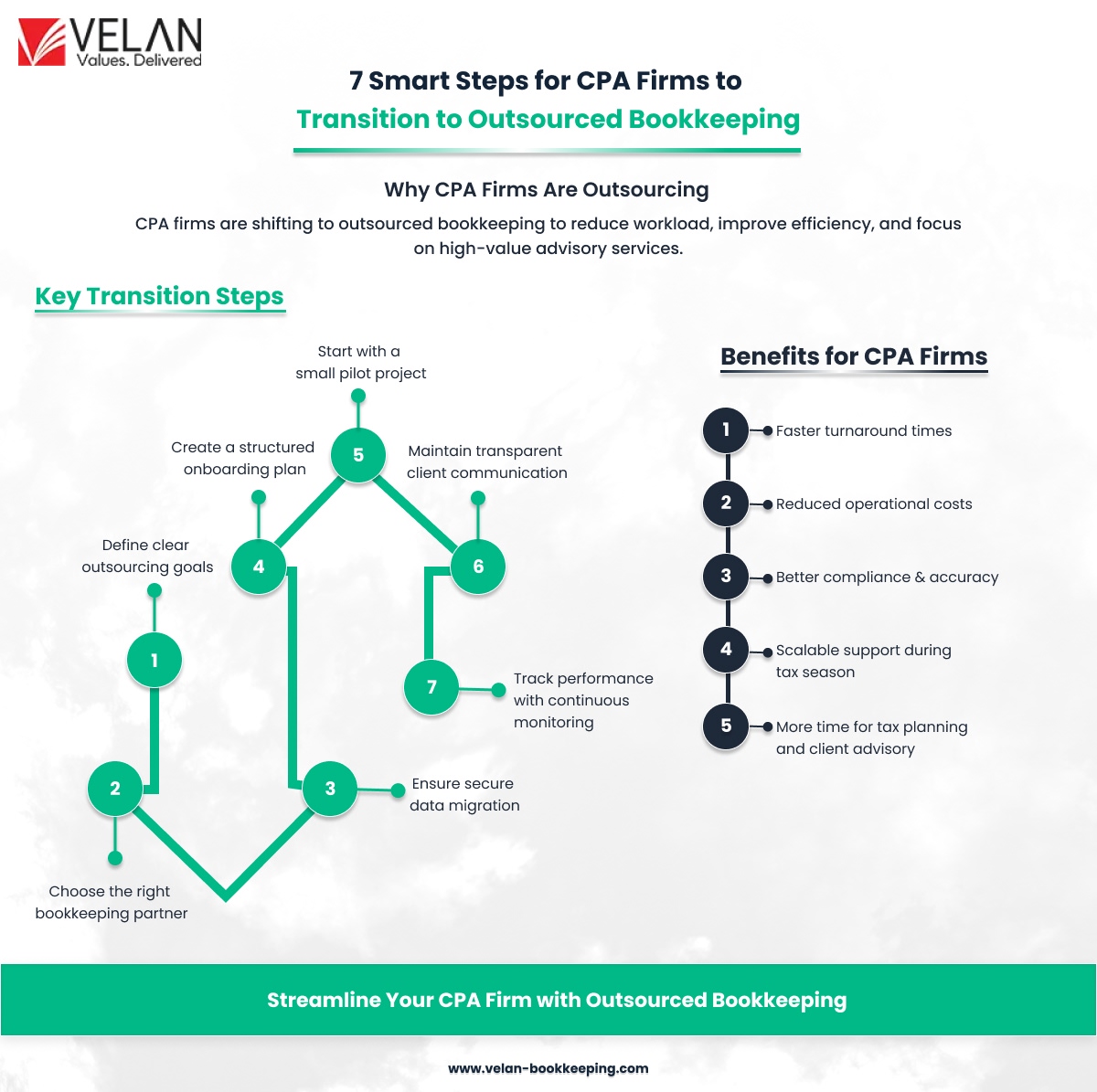
Define Your Objectives Before Partnering
Having clear goals is the first step towards a smooth outsourcing transfer. CPA firms should ask:
- Do we want to reduce operating costs?
- How willing are we to commoditize staff in the name of doing tax, audit, and advisory work?
- Do you need a quick turnaround during tax season?
By clearly defining your goals, you can create an outsourced bookkeeping checklist that suits your company’s aim. For example, if your firm is looking to expand in CFO-level advisory services, we can outsource the data entry, reconciliations, and monthly reporting type of work. Your in-house accountants can focus on strategic planning and meeting with clients using this approach. Defining the outsourced work you want means less ambiguity and a place to begin the win-win negotiation of a service agreement between your company and your outsourcing provider.
Select the Right Outsourced Partner
Not all the cover service providers are equal. Going for the best partner is crucial for natural solutions. Things to look for would be an integrated relationship with a CPA firm adept at QuickBooks, Xero, or Sage Sound and a practical, in-depth understanding of compliance standards in accounting.
Also inquire about their method of communication. Is there going to be only one person you can talk to from their end?
How quickly do they respond to queries?
Just as important, verify their data security policies. A reliable outsourcing partner will have well-documented procedures for running secure data transfer for CPAs that include encryption, access controls, and compliance certifications like SOC 2 and GDPR.
This due diligence up front is what gives your firm confidence to turn over sensitive financial information to the provider.
Prioritize Secure Data Migration
Client data is the currency of business for CPA firms. Screw up its transition, and not only could you betray the trust of clients, but you could ruin the reputation your firm still has left. That’s where we see the value of a well-organized, secure data migration process.
Steps include:
- Sharing files through secured portals or cloud platforms.
- Gaining access based on roles to determine who owns what.
- Ensure data integrity by creating backups before migrating.
To avoid risks, begin the migration by testing with the data of just one client, not all clients at once. It ensures that systems are running as intended and security protocols are airtight.
When CPA firms are able to demonstrate to clients that they have made strides to protect data, they increase confidence and show professionalism.
Develop a Clear Onboarding Plan
Outsourcing is not just about transmitting over a file; it is about establishing a partnership. Successful virtual bookkeeping onboarding requires a well-thought-out strategy, which CPA companies should develop.
This plan should include:
- Posting process documentation and flowcharts.
- Setting up the means of communication (Slack, email, weekly calls, etc.).
- Setting up expectations for turnaround time and escalation procedures.
Training the outsourced team on firm-specific preferences.
If, for instance, your firm does client reports in a specific format, then the outsourced team needs to have report templates and be aware of deadlines.
With that type of onboarding, the outsourced provider does not feel like an outsider—they become a part of your team.
Begin With a Small Pilot Project
Trying to transition everything in one go can be taxing for your team and the provider, too. Begin with a pilot project: bank reconciliations, payrolls, and accounts payable are candidates for testing.
This approach allows you to:
- Test workflows and software integrations.
- Identify gaps before scaling.
So, let’s say, for now, that you only outsource reconciliations for five clients. If the supplier keeps up delivering precise results on time, simply extend to more customers and other services.
Gradually implemented: The risk is also mitigated, and mutual trust is developed between the outsourcing partner and your firm.
Maintain Transparent Communication with Clients
You have clients who entrust you with their financial information, and drastic shifts can make them nervous. Proactive communication is essential.
The following should be communicated to clients when moving to outsourced bookkeeping:
- Why is the transition happening?
- How will it make the results more accurate and faster?
- The security that safeguards their information.
For instance, a CPA firm could post, “By outsourcing your bookkeeping tasks, our in-house accountants will have more time to concentrate on tax strategy and financial planning for your business.”
It’s a framing that depicts outsourcing as benefiting clients—as opposed to being simply an operational change. Transparency fosters trust and keeps clients from feeling sidelined.
Arranging for Feedback Loops and Continuous Monitoring
Transition doesn’t end once you’ve hired the provider. Long-term success is all about continual monitoring and learning.
Key performance indicators that CPA firms should track from the formal creation of a firm through all stages of a firm are:
- Accuracy in reconciliations and data recording.
- Average turnaround time for deliverables.
- Client satisfaction levels.
- Set a schedule for getting together with your outsourced partner to review and discuss how to be more successful, solve problems with a process, etc.
This feedback loop also means that little problems get resolved quickly, before they become big problems. This is a proactive approach that fosters collaboration and makes your business benefit to the possible extent from the outsourcing market.
Conclusion
For CPA firms, outsourcing bookkeeping doesn’t mean transferring work—it means unlocking growth. By outsourcing all the routine work to specialists, operations can spend more time on valuable client services, grow their advisory services, and remain competitive.
Adhering to the above seven best practices—setting goals, selecting the right partner, ensuring secure data transfer between client and CPA, building an onboarding process, starting with a pilot roll-out, providing client transparency, and establishing feedback loops—will make your transition successful and sustainable.
Armed with a well-designed outsourced bookkeeping checklist, CPA firms can confidently welcome the transition to outsourcing, create more value for clients, and prepare themselves for long-term success.
FAQs
Why CPA firms should outsource bookkeeping
Outsourcing enables time saving, reduction in overhead costs, and the ability to concentrate on higher-value services such as advisory and tax strategy.
How can CPA firms guarantee a secure transfer of data when outsourcing?
Through encrypted file-sharing systems, access controls, and backup processes, companies have the means to shield sensitive client data during transfer.
Where is the best place to begin transitioning to outsourced bookkeeping?
Begin with a small pilot, for example, reconciliations or accounts payable, and then assess the performance before rolling out slowly.
Will subcontracting have an impact on my clients?
No, if handled transparently. In reality, quite often, customers themselves feel better served thanks to the increased accuracy and faster turnaround times at their disposal with outsourced work.
Top FAQs on Outsourced Bookkeeping Services for CPAs