

 +1 727 756 1632
 reachus@velan-bookkeeping.com
Accurate management of business finances is important for companies; however, many do not have the time or resources available to perform bookkeeping services internally; thus, utilizing outsourced bookkeeping is an advantageous solution. Understanding the outsourced bookkeeping process will allow the business owner to be confident that they are able to transfer their financial records to a trustworthy third party. The below article provides an overview of the end-to-end outsourced bookkeeping workflow, beginning with onboarding through continued service.
What Is the Outsourced Bookkeeping Process?
The outsourced bookkeeping process is defined as assigning daily financial recording, reconciliation, and reporting duties to a third-party bookkeeping provider. Unlike employing an internal bookkeeper, the company partners with professionals who manage the books remotely by way of secure cloud-based systems.
In addition to providing accuracy, consistency, and regulatory compliance, the outsourced accounting process allows the business owner to focus on growth rather than getting bogged down with administrative paperwork.
How does the outsourced bookkeeping process work for a business?
Outsourced bookkeeping will follow a defined and consistent process that captures all of a business’s transactions, verifies their accuracy, and provides timely financial information to management. We have outlined the steps involved in this process below.
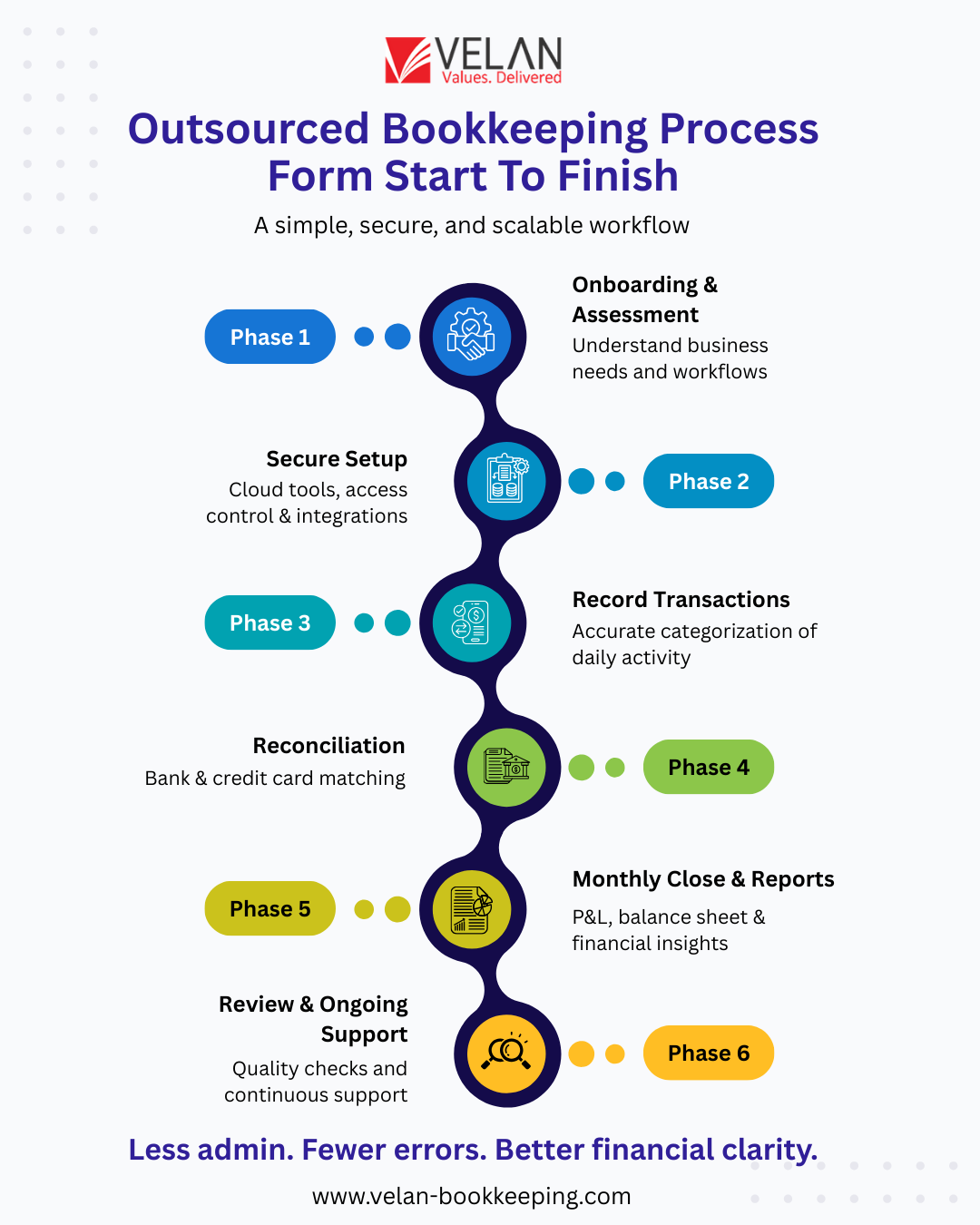
Step 1: Initial Assessment and Client Onboarding
The bookkeeping outsourcing process begins with onboarding. The bookkeeper needs to get to know your business, i.e., gather information regarding your industry, transaction volume, accounting method and what you want to report from a financial standpoint. They will also review existing books and accounts to see where you currently are and identify areas of inconsistency or potential issues.
Step 2: Set Up Data Security and Bookkeeper Access
Now, you can establish safe and secure access to your accounting software, as well as your banking information, payment systems, and other key financial tools. Many service providers utilize a cloud bookkeeping process, allowing for real-time collaboration with clients while keeping client financial information secured and confidential.
The next step is setting up user permissions, integrating necessary applications and configuring reporting so that there will be a consistent flow of information in a structured format to assist in maintaining a controlled workflow.
Step 3: Record Financial Transactions, Classify
Once setup is complete, your outsourced bookkeeping company will begin recording all financial transaction(s). All income, expenses, payroll, journal entries, etc. will be recorded in the correct account category based on the standard accounting method(s) being used by your company.
This is the foundation of outsourced bookkeeping services, and it is crucial to document all financial transactions to provide an accurate analysis of your business’s financial position at any given time.
Step 4: Bank & Credit Card Reconciliations
Bank & credit card reconciliations are an essential component in the outsourced bookkeeping steps. We will look at all of the recorded transactions and compare them to the bank and credit card statements to find any mistakes, duplicate transactions, or transactions that were not recorded. Regular reconciliations allow you to see the true picture of your cash position and help prevent costly errors that can continue to add up over time.
Step 5: Manage Accounts Payable & Accounts Receivable
This is where the bookkeeper provider manages the company’s accounts payable (AP) and accounts receivable (AR). All vendor bills are tracked by the bookkeeper, and they make sure the payment schedule for all vendors is met on time, and the bookkeeper monitors the invoices issued to customers and makes sure the customer pays their bill on time.
This process is one of the most important parts of the outsourced bookkeeping process because it allows businesses to have better control over their cash flow.
Step 6: Monthly Closing & Financial Reports
By the end of every month, the bookkeeper reviews and closes out the books. During the closing process, adjustments such as accruals or depreciation are made and financial statements are created.
Business owners get clear and concise financial reports at the end of every month, which include profit & loss statements, balance sheets, and cash flow summaries. In many ways, the monthly close is the culmination of the end-to-end outsourced bookkeeping process and provides business owners with actionable information about their business.
Step 7: Quality Control, Compliance, and Final Review
Prior to finalizing the report(s), there will be a quality control check of the data to ensure the integrity and accuracy of the data as well as that it complies with accounting rules and regulations and that all relevant supporting documentation has been properly reviewed for each transaction.
An additional level of accountability in the outsourced accounting process is added through this internal review process.
Step 8: Client Review and Ongoing Support
The last step is to provide the client with the report(s) and discuss their company’s financial performance. The client can then ask questions regarding the report(s), make any necessary adjustments, or use the report(s) to develop future plans.
Through ongoing support and communication, the outsourced accounting process can evolve with your business requirements.
What Tools Are Used in Outsourced Accounting Services?
Reputable cloud-based accounting services utilize cloud technology for accounting software, document management systems, secure file sharing and communication with clients. The cloud-based accounting technology helps to provide the automation needed in a timely manner; it also allows for real-time reporting and a streamlined process for cloud-based accounting services.
What is the Timeframe for Outsourcing Accounting Services?
The timeframe will vary depending upon the business size, the number of transactions, and the quality of the records at the onset of the service. Typically the initial setup will take anywhere from 1 to 2 weeks; once that has been completed, the monthly bookkeeping services will follow a routine and consistent schedule. Once a client’s account has been stabilized, their outsourced accounting services should be able to complete the bookkeeping services quickly and efficiently.
Is the Outsourced Accounting Service Safe and Secure?
Yes. Most reputable accounting service companies have implemented robust encryption systems, secure access controls and very strict confidentiality policies. Often, using cloud-based accounting services can be safer than manual or spreadsheet-based systems.
Conclusion
If accuracy, productivity, and scale matter to your business, it is likely that outsourcing is right for you. The structured process of outsourced bookkeeping eliminates many of the errors made when performing these tasks manually, frees up much of the time previously spent doing this type of task, and provides your business with the ability to generate reliable and timely financial information. With a defined process and secure systems, using an outsourced bookkeeping service creates an opportunity for your business to be financially organized so you can focus on growing it.
FAQ
Does outsourcing bookkeeping work for small businesses of all sizes?
Yes, all types of businesses can benefit from the structured steps of an outsourced bookkeeping process as well as professional management of that process.
Does the outsourced bookkeeping service integrate with my current software systems?
Most providers of outsourced bookkeeping services work with the most common accounting and payment platforms.
What frequency do I get financial reports from an outsourced bookkeeper?
Reports are typically sent to clients at least once per month; however, some clients may want their reports to arrive in their email inbox weekly or even in real time.
Do I still have full control over my finances?
The outsourced bookkeeping service increases transparency and allows you to maintain total control over your decisions related to your company’s finances.