

 +1 727 756 1632
 reachus@velan-bookkeeping.com
Property managers weighing Buildium against Propertyware are usually asking one practical question, which platform actually fits the shape of their portfolio? Both are under the parent company RealPage but were created for different types of business models. While Buildium was created keeping in mind community associations, multifamily housing, and student housing, Propertyware was especially created for single family and scattered site rental businesses.
This guide doesn’t begin with the debate but takes you through it step-by-step. There will be a detailed feature-by-feature comparison of real estate and property management bookkeeping capabilities first, followed by how each platform handles trust accounting, then a full breakdown of pricing across both platforms. From there, the guide narrows in specifically on Buildium vs Propertyware for single-family rentals, since that’s where the real decision usually lives. By the end, you’ll know exactly which platform matches your unit mix, rather than paying for capabilities your portfolio doesn’t actually need.
What Is Buildium?
Buildium is cloud-based residential, community association and student housing property management software designed to help property managers. It combines fund accounting, tenant and owner portals, and tracking maintenance costs in a flat monthly fee per tier basis, with no per-unit fees regardless of the number of units in the portfolio.
What Is Propertyware?
Propertyware is an exclusive RealPage solution designed for single-family and scattered-site rental property owners. It’s designed for companies with units in a number of neighborhood or markets, not just a handful of buildings, and with a deep customization focus, along with an open API.
How We Compared Buildium and Propertyware
Our comparison focuses on what matters most to property managers and accounting teams: portfolio type, pricing model, trust accounting, financial reporting, customisation, API capabilities, workflow complexity, scalability, and bookkeeping requirements.
| Feature | Buildium | Propertyware |
| Best portfolio type | Multifamily, HOA, student housing | Single-family, scattered-site |
| Pricing model | Flat monthly tiers | Per-unit, monthly minimum |
| Customization | Standard workflows | Highly customizable, open API |
| Trust accounting | Built in, GAAP-aligned | Built in, portfolio-level |
| Tenant and owner portals | Included | Included |
| Mobile app | Included | Included |
| Implementation fee | Nil | 2x monthly subscription |
| Best for | Concentrated portfolios | Distributed, multi-market portfolios |
Scattered-Site vs. Centralized Portfolio Management: Choosing the Right Solution
- To build Buildium, we assumed some degree of concentration of units at a property, in the same building or within a single HOA.
- Propertyware is built for single family homes in a multitude of addresses, even multiple regions, that each require their own processes, but are looking to standardize those processes.
- Propertyware’s open API also enables managers to manage multi-regional operations, with a single sign-on to local operations.
- In Buildium, Propertyware’s tools that are designed for scattered locations typically save time from doing the same work manually in multiple locations across your average property.
- If the majority of your units are in multi-unit buildings or associations, Buildium’s central design is an easier-to-implement, maintain structure.
How the Trust Accounting works on both?
- Both platforms have in-built trust accounting as both were created for property managers, not property accounting software.
- Buildium’s reserve fund tracking is GAAP aligned, a great fit for HOA and Community Association Reserves.
- Propertyware provides portfolio accounting that can reconcile a single-family unit portfolio that’s so fragmented.
- They both need to have a properly set up chart of accounts to be audit-ready, and neither eliminates the need to reconcile monthly.
How Does Buildium vs. Propertyware Pricing Compare?
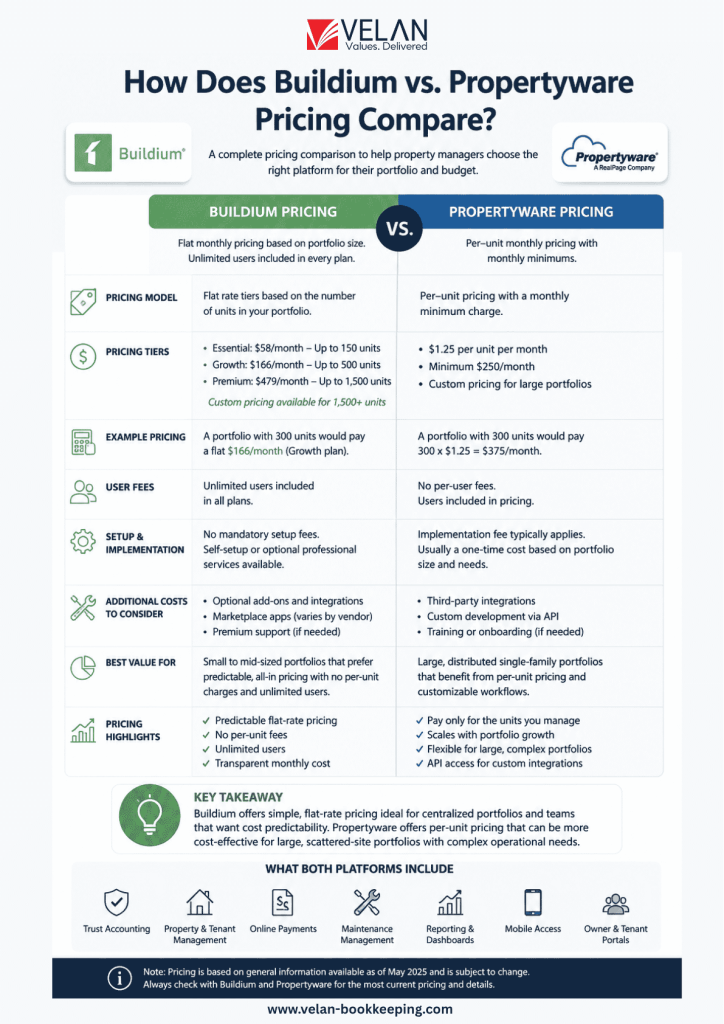
| Tier | Buildium | Propertyware |
| Entry / Basic | Essential: $62/month | Basic: $1.00/unit/month, $250/month minimum |
| Mid-Tier / Plus | Growth: $192/month | Plus: $1.50/unit/month, $350/month minimum |
| Premium | Premium: $400/month | Premium: $2.00/unit/month, $450/month minimum |
| Pricing Model | Flat monthly tiers, no per-unit charges | Per-unit pricing with a monthly minimum |
| Implementation Fee | None | Typically about 2x the monthly subscription |
| Users Included | Unlimited on all plans | Not flat rate; scales with unit count |
In a direct Buildium vs Propertyware pricing comparison, Buildium’s flat monthly tiers are usually more affordable for small to midsize portfolios, since pricing stays predictable regardless of unit count. Propertyware’s per-unit model can look appealing, but its monthly minimums often mean smaller portfolios pay more than they would under Buildium’s flat structure.
Propertyware becomes more competitive once you factor in what you’re paying for. Deep customization and an open API built for scattered-site, single-family operations spread across many market, capabilities Buildium’s flat pricing doesn’t include. So, the real question isn’t which number is lower each month, but whether your portfolio needs Propertyware’s flexibility enough to justify the premium. For most operators, Buildium wins on simplicity; larger, distributed portfolios may find Propertyware evens out over time.
Buildium or Propertyware: Which Should You Choose?
- If you have student housing, fewer units in each building, fewer buildings in each property, or are an HOA, select Buildium.
- If you work with multiple markets, single family homes, and require in-depth customization, then Propertyware is the solution you should consider.
- Predictable flat pricing will be more important to you than getting granular customization, in which case you should pick Buildium.
- If you want to expand into multiple regional centres and are ok with per-unit pricing, then you’ll want to use Propertyware’s open API.
Ultimately, for most small landlords, which is easier to use, Buildium or Propertyware, depends on how long it takes to setup. Buildium’s standard workflows are faster to learn when compared to Propertyware, which will take longer to configure, but can be beneficial for landlords with larger, more spread-out single-family portfolios.
FAQs
Is Propertyware owned by RealPage?
Yes. RealPage is the parent company of Propertyware, and therefore of Buildium. While RealPage may have plans to extend Propertyware’s property type coverage to additional classes, it’s still an effort to create a single-family and scattered-site only product.
When it comes to single-family rentals, Buildium or Propertyware?
For single family and scattered site rentals, Propertyware’s scattered site tools and open API provide an advantage to larger, multi-market portfolios. Even if you’re not looking to customize the product, Buildium is a great alternative to its higher prices for smaller, single-family purchases.
Are you able to convert to Buildium from Propertyware?
Yes, but there are a few things to consider. First, you are going to have to move your old data to a new system and second, you will need to rebuild your chart of accounts. Make sure there is overlap time with both systems operating simultaneously until the new one has been fully reconciled.
How does chart of accounts setup differ between Buildium and Propertyware?
Buildium and Propertyware both require a properly structured chart of accounts (COA) to maintain accurate property accounting and financial reporting. The key difference is less about whether a COA exists and more about how the accounts need to be structured around the portfolio’s accounting requirements.
Which is better for HOA and community associations, Buildium or Propertyware?
Buildium is the better fit based on the portfolio types described in the document. Buildium was designed to support community associations and includes reserve fund tracking that is described as GAAP aligned.
Which is better for multifamily property management?
Buildium is positioned as the better fit for multifamily portfolios, particularly where properties and units are more concentrated rather than distributed across many locations.
Which platform offers more customization, Buildium or Propertyware?
Propertyware is positioned as the more customizable platform. The comparison describes Buildium as using more standard workflows, while Propertyware emphasizes customization and an open API.
Get support from an expert for either of the two platforms.
With either Buildium’s flat-fee simplicity or Propertyware’s scattered-site customization, professional bookkeeping will have your portfolio audit ready. Discover which bookkeeping services are best for you and your portfolio, with Velan’s Buildium bookkeeping services and Propertyware bookkeeping services.
Expert Real Estate Bookkeeping Services